Friday, November 11, 2011

Trailer-Review

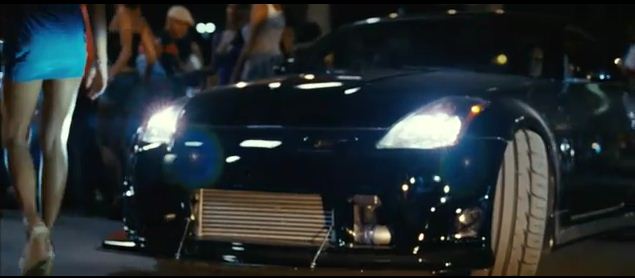
The trailer that I reviewed was the Fast Five trailer. This is the fourth movie of the Fast and Furious film series. This movie came out during the summer of 2011. Fast Five is based around street racing and how it has carried on into other parts of the world. This movie highlights the illegal aspects of street racing; such as, stealing cars, racing, and the police. I choose to review this trailer, because I enjoy the fast paced action portrayed in the trailer.

This trailer, like any other trailer, establishes the narrative of the movie. It establishes that the movie will take place in Rio De Janeiro, Brazil by using a fly over shot of Rio’s famous statue that sits on top of the mountain. The movie then reveals a sweat shop where money is being counted for drug dealers. It then introduces guns and police voice (Dwayne Johnson) to establish a conflict with the police and the main characters. Dwayne Johnson says “Don’t ever let them get into cars”, which highlights what fast and furious is known for, which is street racing. Vin Disel says “we will do one last job and then disappear forever”, suggesting that this is the last movie of the series. This quote is followed by a series of expensive cars being stolen off a train, establishing that the characters will steal in order to make their money. The trailer also reveals the old characters from prior movies who are back. This movie hints that Han did not really die in the seemingly fatal car accident during Tokyo Drift, or that this series takes place before Tokyo Drift.

The cinematography adds to the high paced action expressed in the trailer. The fast and close up shots of the cars displays that the cars will being going fast in the movie. The track over the police lights while Dwayne Johnson is speaking establish Dwayne Johnson as the police who are after Vin Disel and his men. The P.O.V of the rocket launcher explosion adds to the action of the movie. The close up of Vin Disel and Paul Walker’s hands as they hook their winches onto what seems to be two metal bars. This creates curiosity in not displaying what they are hooking onto. Then a wide shot shows that the metal bars where actually part of a metal vault that is being pulled by two cars.

The editing is what makes the trailer a high paced trailer. One of the best techniques is used at the end of the trailer where there is fast editing between different scenes that intertwine with a heart beat. As the heart beats become faster the cuts become faster and finally reveal the name of the movie.

The sound is also a crucial part when creating  trailer, for it helps to reveal the situation and synchronizes with the action. In the beginning the cliché sound of a shotgun adds to the intensity of the robbery scene. The fast paced music that is infused with the sound effects of squealing tires reveals the fast plot and cars.

Monday, October 3, 2011

Run Lola Run Presos Critique: Editing

run lola run preso
The area that my group and I explored in Run Lola Run was editing. The editing style that I found Run Lola Run to be based off was a formalistic style. This film was a formalistic movie because it defies most classical editing techniques. One of the first things that makes this a formalistic style is the repeat of the same sequence of time 3 times by Twyker. There is a manipulation of time, because are 3 Acts of the same plot where the characters progress and realize their mistakes as the movie progresses. Formalism is also seen in the use of thematic montage of still frames. The abstract of formalism is also emphasized in the use of animation. One significant use of animation is when an animated character pulls the frame in just before the camera does a 360 around Lola as she thinks of who to ask for money. I also found the abstract to be in the breaking of the fourth wall by Papa shaking his head as Lola runs out of the frame. I also addressed parallel action and split screen. Parallel action and split screen are used in points of high tension, for example when the money bag and the phone are falling after Lola gets shot. I lastly examined cutting and how there were around 1500 cuts in Run Lola Run.

I had some strengths in my presentation. I think one of my strengths was that I was able to not rely heavily on my notes. I was able to expand on my pictures and talk relative to my topic. I think I was also able to provide good facts about the movie, such as the average shot length of 2.7 seconds. I was also to have a somewhat good sense of film language.

I also had some weaknesses in my presentation. I feel that I did not use enough film language. This can be solved by further studying the advanced editing notes. Sometimes I strayed off topic with the breaking of the fourth wall, because it is not really an editing technique. I sometimes also said like and ummm, and I also didn’t always look at the audience when I was talking. I looked too much at the screen and not the audience.

Thursday, September 29, 2011

Film Treatment: Sands

Film Treatment: Sand

Logline: Boy is running through San Francisco attempting to tell his best friend that he likes her. Boy breaks fourth wall.

Girl and boy are sitting on a beach near sunset. They are looking out into the ocean. Girl says “look at this sand in my hand”. She cups the sand and lets its slowly siphon down until there is no more sand. She says this sand is like time it eventually runs out for all of us. The question or not is how we live our lives to the fullest. As the guy and girl leave the beach they part ways.

As the boy walks home he breaks the fourth wall and tells us about his life. His name is Tom and the girl’s name is Kelly. He and Kelly have been friends ever since they were small kids. Flash back to smaller kids on a play ground and they meet each other and are instantly friends after. Tom is a junior in high school and Kelly is a Senior. He and Kelly always enjoy each others company and they spend a lot of time with each other and their other friends.

Show progression of shots to show that the year is going by and then the year is almost over until it is summer time again. Tom and Kelly are on the beach again. Kelly tells Tom that she is going to leave tomorrow for college. Tom is sad but says alright and when they part ways they say good bye to each other.

The next day when the boy gets up his mom leaves a pile of pictures on his desk. Tom looks through the pictures and finds an old picture of him and Kelly. He breaks the fourth wall and tells the audience that he realizes his feelings for Kelly and wants to tell her before she leaves at 12 pm for UC Irvine. It is 11:00 pm and the boy realizes he must go to Kelly’s house fast so that he can tell her his feelings.

Tom runs out of his house and runs down the street. He finds the bus stop and waits as he looks at the time to make sure that he is not going to be late. As he is running he is having flashback memories of all the good times that he and Kelly had together. Tom encounters obstacles on the way and then he doesn’t make it in time to tell Kelly his feelings. He is sad but tells the audience that he tried his best and ended up failing.

Sunday, September 11, 2011

Broadcast Critique (how technology contributes to procrastination)


            Preproduction was extremely difficult. Me and max wanted to do something great or special, so we wanted a great idea. The only problem was that we couldn’t think of a great idea. One of our first ideas was the Casey Anthony case, but Mr. Bigue said that was too boring. Then finally we wanted to do a segment on procrastination, but also teachers using technology. I came up with this idea because I know procrastination is a big thing, but also I wanted to include ideas about a RSA segment that I watched about changing education paradigms. Max wanted it to be professional so we only envisioned one interview and voiceover. We decided to interview Ms. Gonzales because we had a conversation about the RSA segment with her before.
            I thought the overall quality of production was pretty good. Some of our most creative shots were the rack focuses, and the narrow depth of field shots. I enjoy isolating one person in a narrow depth of field shot, because it looks better and the person has less chance of noticing that you are recording them since you are farther away. One of the best shots was our interview segment with Ms. Gonzales. It was the first time I used the lighting kit, so I made some mistakes. It would have been better if she was more diagonal to the wall and she was framed more on the right side of my frame. Our audio came out good, but I was afraid that it might be horrible like it has been in the past. This was probably a benefit from using only one camera, and not the 7D that has great picture quality but poor audio.
            Our script wasn’t that great and had to be changed at the last moment. It turns out that we had two different topics that didn’t quite go together all in one segment. My favorite shot of Ms. Gonzales had to be removed because there was no relativity. It was a good thing that the voice over from before still flowed with the new interviews. I thought the voice over was compelling and related to our story. I liked the part about how we are living in the most stimulating era of human kind. I felt that the voice overs flowed well with the b-roll that showed kids doing hw, watching tv, and multi-tasking. The final thought that I want people to take into account are the tips on how not to procrastinate. Procrastination can be a great kid’s kryptonite.
            I thought the editing in our segment was decent. It reflected most of the segment, except for a rack focus shot we did in the beginning of a pencil sharpener. I felt that minimal transitions were necessary, for segments on tv just use cuts. We faded audio at the end, and I felt that transition was essential. The only effect that I used was the gain tool, which I never used before. It is extremely helpful, and I was able to get great audio quality by just boosting the gain.
            Overall I like that our piece addresses procrastination, which all most every teenager struggles with. I wouldn’t really do anything differently except do another segment on technology in classrooms. The most important lesson I can take away is that even if you have great shots, story line matters. If your story doesn’t make sense then it is useless.

Thursday, September 8, 2011

Character in Time

The man in this picture is an old man who is 71 years old. The man is fishing on his lawn chair on a platform. He is fishing at dusk, because dusk is one of the best times to fish. The old man is having a relaxing day after driving in his van that is parked next to him. The man is reflecting on his road trip. He then realizes that the moment that he is living in is extremely peaceful. The worries of life are erased from his mind and he is in total relaxation. He examines the beauty of the sunset and reminisces about a sunset in Vietnam. He and his comrade were sitting near the ocean in Vietnam watching the sun set over the ocean. They were both waiting for the helicopter to return them to base after their successful mission. The old man remembers the good times he had with his battalion during his service years in Vietnam. Then as the sun begins to fade he questions life. He realizes that life is beginning to fade away from him just like the sunset, because he is 71 years old. As he stares out into the horizon, he contemplates what he wishes to do before he passes.

Sunday, August 28, 2011

Cameria In Action Response


Too Fast by WongFuProductions

The film that I analyzed was "Too Fast" by WongFuProductions. It is about a man named Brandon who likes to do everything in his life fast. Ever since he was little he has gone fast and there are positives and negatives to his speed. The short film plays around with time and physics, because Brandon is able to do outrageous things. An example is when he is able to go from home to drop off his friend in a second, and then in another second he is able to get a tapioca drink.

     There are many variations of shots throughout the short film. In the picture above a medium close up is used. The camera is at a slight diagonal to Brandon's body, which gives the shot a little bit of depth. The short film opens with an establishing long shot of the car on the lower right hand corner of the frame. Our eyes are drawn to the blue car because the blue contrasts with the setting of the trees and the house. The next shot is then a pov shot of the red light that Brandon is looking at as he waits for the light to turn green. This is followed by a close up shot of the tactometer as Brandon revs the engine. This shot portrays portrays Brandon's anxiousness to go fast. The next shot is a close up used with a narrow angle lens that uses the shallow depth of field to isolate Brandon's enthusiastic face as the light turns green. The sense of depth in the shot is added by Brandon's hands on the steering wheel that are out of focus.

      The lighting in the short film was good, except for the restaurant scene. A high key light was used to light this scene, when a medium to low key light may have been a better choice. A high key light that is white contrasts to heavily with the low yellow lighting of the romantic restaurant shown in the first picture. I believe the high key light is too intesne because it creates an odd white light on Brandon as seen in the seocnd picture. A yellow or softer filter on the light may have made the scene better by preserving the continuity of the low lit romantic setting.


     The final scene is my favorite scenes. The scene opens by using a pan movement while using lead room as Kelly walks to Brandon's car. The shot is out of focus as the pan begins, but the shot is in focus when Kelly gets into the car. This was probably caused by the presetting of the focus on Kelly as she was in the car before the shot started. The next portion of the scene is dialogue between Brandon and Kelly where medium close ups and selective focus are used as the two actors talk to each other. This seems to be a popular style throughout the movie. The cinematographer tends to use a narrow zoom position and create a blurry foreground and background, while leaving the midground clear. I enjoy this technique, because the shot is able to include all 3 aspects (foreground, midground, and background) by keeping the shot static without having to rackfocus or move the camera. 
The next quick shots are of when Kelly realizes that they now have 2 kids only after a few seconds of talking to Brandon. A quick pan is used from Kelly to her new kid saying mommy. This is then followed by a quick cut to her face. The quick pan and cutting display the rush of suprise and horror that Kelly feels from having no kids to two kids in a second. Overall I felt that the cinematography was strong and the shot variation reflected the pace of the plot.


Monday, April 11, 2011

Production Portfolio: The Retreat

Rationale: We produced a film called the Retreat, which was about a boy who loses his dad. The boy goes to a trail with a girl to help him clear his mind. The girl is a catalyst for the boy to overcome his sorrow, for she recreates the moments that the father and the son had on the same trail. Initially we wanted to do a movie based on sound that included the new techniques that we learned in class; such as, sound bridges, degetic and non-degetic sounds. We made this film for all audiences, to commemorate anyone who has lost a love one. We thought this was a good idea because it did not involve a story line with a lot of actors, or unrealistic sets.

Commentary: My position or responsibility throughout the production of the short film was Cinematographer. I was in charge of all the equipment and most of the film making process. Most of the cinematography was done by myself, but the director did some of the cinematography when I was unable to shoot. The most important factor of my job was getting to know/ handle the new camera, which was the cannon 7D. The cannon 7D is an amazing piece of equipment, but it is complicated and needs to be used several times to gain experience.

Initially I had written the script for the movie, but it was too vague. I based my script off of a set that I had desired to use, and we stuck with the main idea of a script based around a trail where a boy can retreat from his daily life. We had to rewrite the script at least 3 more times. After the first script I wrote the second script, but the second script too was also unsuccessful. It was not until the 3rd treatment that we were able to get an approved treatment. This treatment was succesful because all three of us in the group put our heads together and all collaborated on a google doc. After this was complete myself and the director wrote the script. After the script was finished I produced the 2 column script that included all my shot sequences. I did not rely on the 2 column as much as I desired to because, when we shot at elephant bar the set changed from what I initially thought would be a trail near Crystal Springs.

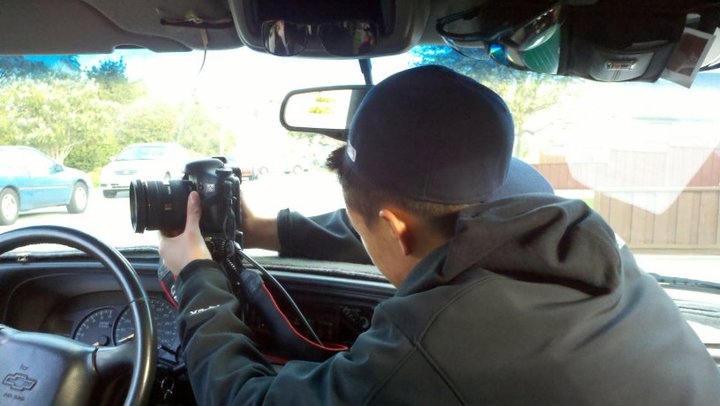
The most challenging part of handling the 7D was attachable audio box that allowed us to use a three pronged mic cable and better the sound of the movie. A main problem that I had was that when I used it the first time to shoot I forgot to plug the cable from the box into the camera, thus the day of shooting was a lost, because we were unable to get audio. This can be seen in the picture to the right, and examined closely one can see that the wire is hanging out of the mic box and not plugged into the 7D. I accepted all the blame for this mistake, because I was the one responsible for the equipment and most importantly the camera. From that day on I have always checked the box to make sure it has enough batteries, made sure the shot gun and cable are working, and have made sure that the cable from the box is plugged into the camera. And now I always replay the scenes that I shoot with the director to make sure that the audio worked in the scene.

Audio throughout production seemed to be a constant problem. A problem that we had in the produciton was that we used three different cameras in our production, because priority for the 7D was given to seniors. When we shot the cemetary scene we had to use the HFM, which is an HD camera, but it is not made for proffessional productions like the 7D. Another fault of mine was that I had forgotten to check the shot gun mic before I checked it out. The shot gun mic was out of batteries and it was unable to record our only setence of audio. The audio had to be dubbed, but it was not too obvious. From now on I always check all the gear to make sure everything works and has batteries.

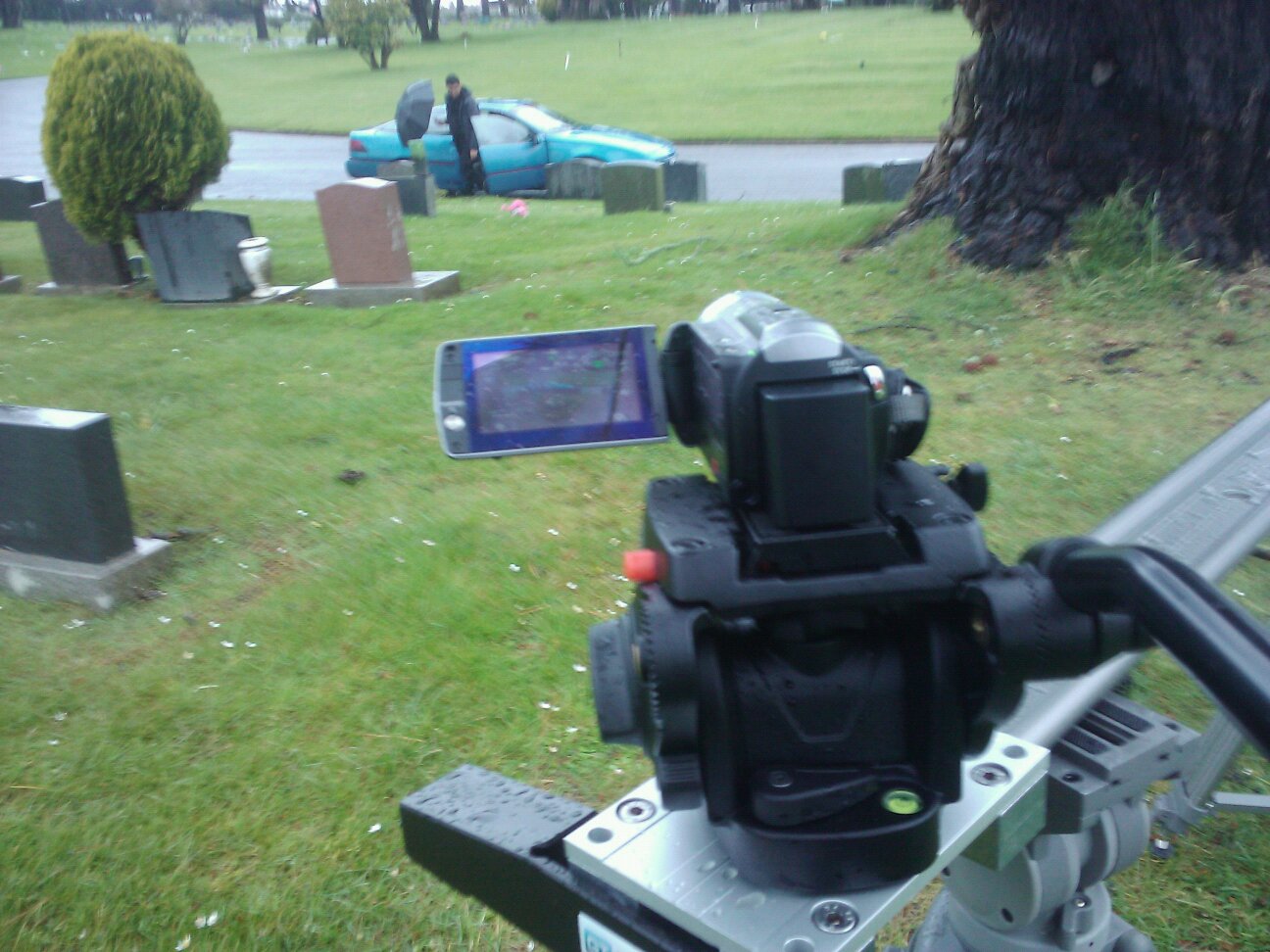
When I shot the cemetary scene we wanted it to be raining and it was raining. A problem with the rain is that it falls onto the lens and I constantly have to wipe the lens and try to protect the camera from the weather in the pocket of my jacket. Although the drops of water were a problem, they were also a benefit for the drops created contrasting colors seen in the picture to the left. The drop disorients the shot in the left top corner of the picture.


Using the dolly track in the rain is also a very difficult task that I had to overcome. The dolly track is already a tough contraption to set up, because it needs two tripods and the baseplates have to be screwed into the bottom of the track. Because it was raining the dolly track was getting wet; thus, the rain acted as friction to the top plate that slides along the track. In order to not have the dolly track stop and hold the umbrella over the camera, I had to maintain a speed that was higher than I desired. It worked out perfectly though, because moments after the track came to an end the car door slams. Leveling the dolly track on the uneven grass was also a difficult task.

The editing in the movie I believed went fairly well. We were able to use color correction in our film for the first time to give it a cinematic look. My favorite filter is with Ben and the Father. As in the words of the director "its not necessarily black and white, but it has come color contrast to it". This filter gives the a retrospective outlook on the event, without being cliche with using a simple black and white filter. Editing also involved cross fades for the volume, because the volume was high pitched before anyone spoke.

I felt that the sound design went extremely well, mainly because of our director. Our director became the audio technician and found loops and music on youtube that we were allowed to use. He also included background noises that seemed unnoticable at first, but play a key role in maintain ambience noise throughout each scene.

The directing of the production went well.except for some problems. Our director played the largest role in our whole production, from helping with cinematography to helping with editing and audio. Some problems with directing was getting the full emotion out of our characters. I feel that without strong actors the quality of the movie as a whole is brought down.

For myself I have many areas to improve on with my skills as a cinematographer. Maintaining shots that are more unshaky is one of my main goals. In the next project I want to incorporate more moving shots and different camera angles. I need to always check gear all the time to make sure that a day of shooting doesnt go bad because of my failure to check gear. Maintaining focus is an aspect that I also desire to improve on. Instead of being lazy and focusing without zooming in live view, I should zoom in in live view and make sure that the focus is correct.

Overall I feel that the production of the movie is my best work so far. The movie surpassed my expectaions in areas of camera work, editing, and sound design. The two major areas we have to work on next time is getting the correct emotion from the actors, and a wider variety of cinematography.