Rationale: We produced a film called the Retreat, which was about a boy who loses his dad. The boy goes to a trail with a girl to help him clear his mind. The girl is a catalyst for the boy to overcome his sorrow, for she recreates the moments that the father and the son had on the same trail. Initially we wanted to do a movie based on sound that included the new techniques that we learned in class; such as, sound bridges, degetic and non-degetic sounds. We made this film for all audiences, to commemorate anyone who has lost a love one. We thought this was a good idea because it did not involve a story line with a lot of actors, or unrealistic sets.
Commentary: My position or responsibility throughout the production of the short film was Cinematographer. I was in charge of all the equipment and most of the film making process. Most of the cinematography was done by myself, but the director did some of the cinematography when I was unable to shoot. The most important factor of my job was getting to know/ handle the new camera, which was the cannon 7D. The cannon 7D is an amazing piece of equipment, but it is complicated and needs to be used several times to gain experience.
Initially I had written the script for the movie, but it was too vague. I based my script off of a set that I had desired to use, and we stuck with the main idea of a script based around a trail where a boy can retreat from his daily life. We had to rewrite the script at least 3 more times. After the first script I wrote the second script, but the second script too was also unsuccessful. It was not until the 3rd treatment that we were able to get an approved treatment. This treatment was succesful because all three of us in the group put our heads together and all collaborated on a google doc. After this was complete myself and the director wrote the script. After the script was finished I produced the 2 column script that included all my shot sequences. I did not rely on the 2 column as much as I desired to because, when we shot at elephant bar the set changed from what I initially thought would be a trail near Crystal Springs.
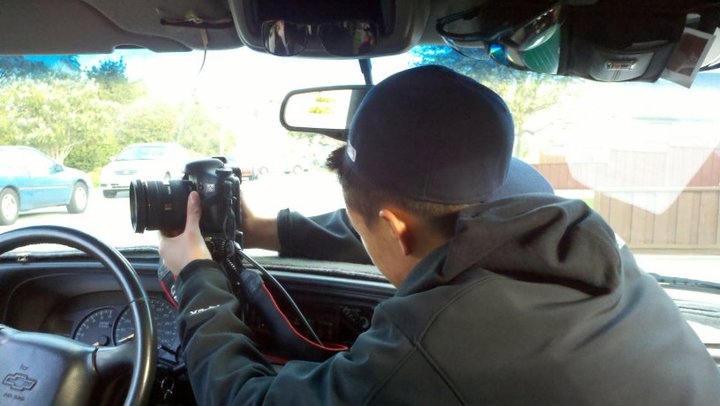
The most challenging part of handling the 7D was attachable audio box that allowed us to use a three pronged mic cable and better the sound of the movie. A main problem that I had was that when I used it the first time to shoot I forgot to plug the cable from the box into the camera, thus the day of shooting was a lost, because we were unable to get audio. This can be seen in the picture to the right, and examined closely one can see that the wire is hanging out of the mic box and not plugged into the 7D. I accepted all the blame for this mistake, because I was the one responsible for the equipment and most importantly the camera. From that day on I have always checked the box to make sure it has enough batteries, made sure the shot gun and cable are working, and have made sure that the cable from the box is plugged into the camera. And now I always replay the scenes that I shoot with the director to make sure that the audio worked in the scene.
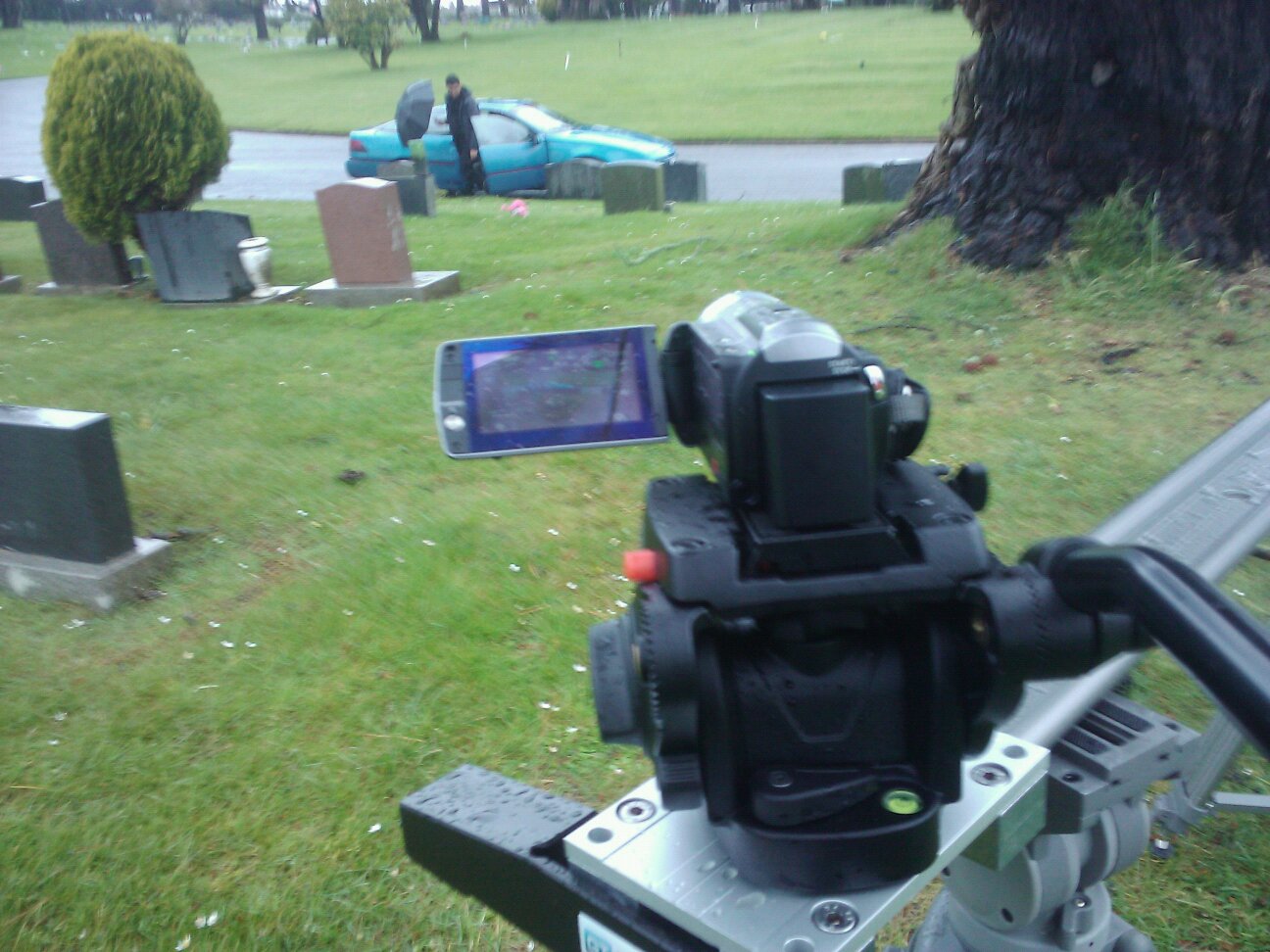
Audio throughout production seemed to be a constant problem. A problem that we had in the produciton was that we used three different cameras in our production, because priority for the 7D was given to seniors. When we shot the cemetary scene we had to use the HFM, which is an HD camera, but it is not made for proffessional productions like the 7D. Another fault of mine was that I had forgotten to check the shot gun mic before I checked it out. The shot gun mic was out of batteries and it was unable to record our only setence of audio. The audio had to be dubbed, but it was not too obvious. From now on I always check all the gear to make sure everything works and has batteries.
When I shot the cemetary scene we wanted it to be raining and it was raining. A problem with the rain is that it falls onto the lens and I constantly have to wipe the lens and try to protect the camera from the weather in the pocket of my jacket. Although the drops of water were a problem, they were also a benefit for the drops created contrasting colors seen in the picture to the left. The drop disorients the shot in the left top corner of the picture.
Using the dolly track in the rain is also a very difficult task that I had to overcome. The dolly track is already a tough contraption to set up, because it needs two tripods and the baseplates have to be screwed into the bottom of the track. Because it was raining the dolly track was getting wet; thus, the rain acted as friction to the top plate that slides along the track. In order to not have the dolly track stop and hold the umbrella over the camera, I had to maintain a speed that was higher than I desired. It worked out perfectly though, because moments after the track came to an end the car door slams. Leveling the dolly track on the uneven grass was also a difficult task.
The editing in the movie I believed went fairly well. We were able to use color correction in our film for the first time to give it a cinematic look. My favorite filter is with Ben and the Father. As in the words of the director "its not necessarily black and white, but it has come color contrast to it". This filter gives the a retrospective outlook on the event, without being cliche with using a simple black and white filter. Editing also involved cross fades for the volume, because the volume was high pitched before anyone spoke.
I felt that the sound design went extremely well, mainly because of our director. Our director became the audio technician and found loops and music on youtube that we were allowed to use. He also included background noises that seemed unnoticable at first, but play a key role in maintain ambience noise throughout each scene.
The directing of the production went well.except for some problems. Our director played the largest role in our whole production, from helping with cinematography to helping with editing and audio. Some problems with directing was getting the full emotion out of our characters. I feel that without strong actors the quality of the movie as a whole is brought down.
For myself I have many areas to improve on with my skills as a cinematographer. Maintaining shots that are more unshaky is one of my main goals. In the next project I want to incorporate more moving shots and different camera angles. I need to always check gear all the time to make sure that a day of shooting doesnt go bad because of my failure to check gear. Maintaining focus is an aspect that I also desire to improve on. Instead of being lazy and focusing without zooming in live view, I should zoom in in live view and make sure that the focus is correct.
Overall I feel that the production of the movie is my best work so far. The movie surpassed my expectaions in areas of camera work, editing, and sound design. The two major areas we have to work on next time is getting the correct emotion from the actors, and a wider variety of cinematography.
Monday, April 11, 2011
Tuesday, March 1, 2011
Oral Presentation Critiques
My oral presentation provided insight on Remember the Titans. I covered various topics throughout the movie, such as the cinematography, score, and plot line. I spent a lot of time on the sociocultural context on how the movie was based heavily around racism and segregation during the Civil Rights Movements. I related the movie to Coach Carter and how Remember the Titans is a similar sports film of crisis. The struggles that the players face, and their ability to conquer their divides allows them to join together and be a winning team. The analysis of the good sets and cinematography within the sets added to the movie's greatness. The key roles of actors such as Denzel Washington made the movie. A negative aspect of my analysis was that I spent too much time on the sociocultural context of racial segregation and might have been too repetitive. Overall I would give myself a 19.
Monday, February 7, 2011
Narritive and Scene analysis
The film is constructed around the story of a newly intergrated highschool football team that is experiencing intense racial divides within the team. Coach Boone played by Denzel Washington is keen on bringing the team together, and force them to break racial divides. The plot sequence is organized in home (virginia), summer camp (Pensylvania), and back home to virginia. Virginia symbolizes the intense racial segregation the boys face. Summer camp is their high where they are all able to reconcile and become friends. When the players get back to Virginia they are tested, because there is no longer a stable environment around them that coach Boone is able to regulate. Our engagement of the characters is feeling jubilance and sorrow. Gerry Bertier's car accident, which causes him to become paralyzed from the waste down is a heartbreaker, for the cliche happy ending is somewhat crushed by one of the maincharacters being paralyzed.
The characters are represented as epitomes of the social era. They are all given cliche traits, the whites are portrayed as racist, and the blacks are portrayed as having soul and spirit. The acting of Bertier and Julias allow us to feel for the characters as they start their friendship with "Strong side, left side". The cinematography is not outstanding, but it is not bad. There are some creative shots of tilting when the players are running to Gettyburg cemetary. A nice shot is when the players can be outlined in the shadows of the schoool bus headlights when they players are forced to play in the dark. The slight overexposed shots allow the audience to be somewhat taken back into 1971. Locations were key, such as Gettysburg cemetary. This is where Coach Boone tells the players that they will end up like the men in the cemetary if they dont get along. The players start to realize that they must work together if they have any hopes of success. Music is also a key aspect of the movie, for it is mainly used to portray the music that blacks like listening to. The soul and gossipal music is stereotypical black music that portrays the black society. This music is used to incorporate happiness and emotion. The movie allows the audience to see that racial and social barriers can be broken as long as people are willing to break those barriers.
Sunday, January 30, 2011
Historical and Socio-cultural context
II. This movie was directed by Boaz Yakin who was born in 1966 in New York City. He attended school in the bronx and studied film making at New York City College, and later moved onto New York University. He won the Sundance Film makers trophy in 1994 for his direction of Fresh. Remember the Titans was the first film that Yakin directed that was a major box office success. The film was produced by walt disney and contained the aspiring actor, Denzel Washington who played a great role as the headcoach. Remember the Titans grossed over 115 million dollars.
III. The socio-cultural context was based around racism and segregation of within the US. The plot was based around the story of a integrated football team that was racially divided between blacks and whites. Remember the Titans addresses one of the most critical topics in US history, which is racism and segregation. This movie portrays a black coach having the ability to break the racial divides within his team to produce a successful team that allows the community to see the ability for both races to trust each other. This work was intended for the entire world to be its audience, for it addresses racism which is a great problem thoughout the world. The intended audience was also for people who like american football, and those who enjoy seeing team work bring people closer together.
Thursday, January 27, 2011
Sound Unit Prepro
This will take place at crystal springs trail on a bench overlooking the spring. Near sunset, since sun sets over the spring.
Logline:
Boy walking (head down) sits down on park bench. He sighs as he sits down. He puts his face in his hands in distress as a young couple walks by behind him. They look to be as though they are in love and are talking to teach other and as they pass the bench the boy looks at their backs as they walk away and their audio fades out. The boy sighs again and then takes out his headphones and we can hear the music from his ipod.
Then middle age couple walks by in the background from right side. The boy doesn’t notice, but they talk about how they always love coming back to this trail and how peaceful it is.
Boy is looking out at the spring as they are walking by and they exit off screen
Then old couple walks by from left side and they sit down next to the boy on the bench. Boy takes off his headphones and says sure you can sit here.
Old couple are talking and they are audible and they are talking about how much they enjoy each other, boy puts his head back down in his hands still in distress.
Old people respond. Old man tells him some words of wisdom about relationships (not too cliché) maybe some humor about himself and his wife.
Old lady says time for us to go, so they both get up, old man tells boy it will be “alright kid pull through”.
After they leave out of the WS. All isolated sounds. Boy relaxes back in his park bench and looks at the spring again (hears small sound of waves). Boy looks at Grass and hears the sound of crickets, and soft wind sound as wind is blowing nearby grass. (if theres no wind it will have to be man made and sound effect can be put in later). Boy looks at free way in back of him and notices sound of cars passing by. Boy looks out at the spring once again and now all sounds are audible. Boy pulls phone out of his pocket with right hand. Looks at it (seems like he is contemplating something) then puts phone down, face down, on his right leg and slouches further back in bench. ONLY THING AUDIBLE Phone starts ringing (ringtone differences genuwine or some r&b song). Boy turns his phone back over and looks at the front and caller ID says Katy and picture is of boy and Katy smiling (happy). Boy looks at it then looks out at spring and left to right (now all previous sounds in green are heard) then he looks back at phone (only ringtone is heard) boy contemplates and then pushes silent on his phone. (WS from beginning) Gets up and walks out of frame. Time lapse until night time then fade out.
Narritive:
The narritive design is a romantic. My goal of this film was to be serious throughout the whole film. I have gone on this trail many times before, and I always notice how nice and serene the view is, although the freeway is right behind it. I based most of the story off of the scene and what i could get of it. I want to experiment with isolated sounds, and then joining all the sounds together to create a soothing nature effect.
Production elements:
I wanted to incorporate nature with sound. I want to use sound bridges maybe to connect different trasitions. I planned on using the music the boy was listening too and his ring tone to play as the lietmotif, and I was also thinking about incorporating some sound loops or even create my own.
Logline:
Boy walking (head down) sits down on park bench. He sighs as he sits down. He puts his face in his hands in distress as a young couple walks by behind him. They look to be as though they are in love and are talking to teach other and as they pass the bench the boy looks at their backs as they walk away and their audio fades out. The boy sighs again and then takes out his headphones and we can hear the music from his ipod.
Then middle age couple walks by in the background from right side. The boy doesn’t notice, but they talk about how they always love coming back to this trail and how peaceful it is.
Boy is looking out at the spring as they are walking by and they exit off screen
Then old couple walks by from left side and they sit down next to the boy on the bench. Boy takes off his headphones and says sure you can sit here.
Old couple are talking and they are audible and they are talking about how much they enjoy each other, boy puts his head back down in his hands still in distress.
Old people respond. Old man tells him some words of wisdom about relationships (not too cliché) maybe some humor about himself and his wife.
Old lady says time for us to go, so they both get up, old man tells boy it will be “alright kid pull through”.
After they leave out of the WS. All isolated sounds. Boy relaxes back in his park bench and looks at the spring again (hears small sound of waves). Boy looks at Grass and hears the sound of crickets, and soft wind sound as wind is blowing nearby grass. (if theres no wind it will have to be man made and sound effect can be put in later). Boy looks at free way in back of him and notices sound of cars passing by. Boy looks out at the spring once again and now all sounds are audible. Boy pulls phone out of his pocket with right hand. Looks at it (seems like he is contemplating something) then puts phone down, face down, on his right leg and slouches further back in bench. ONLY THING AUDIBLE Phone starts ringing (ringtone differences genuwine or some r&b song). Boy turns his phone back over and looks at the front and caller ID says Katy and picture is of boy and Katy smiling (happy). Boy looks at it then looks out at spring and left to right (now all previous sounds in green are heard) then he looks back at phone (only ringtone is heard) boy contemplates and then pushes silent on his phone. (WS from beginning) Gets up and walks out of frame. Time lapse until night time then fade out.
Narritive:
The narritive design is a romantic. My goal of this film was to be serious throughout the whole film. I have gone on this trail many times before, and I always notice how nice and serene the view is, although the freeway is right behind it. I based most of the story off of the scene and what i could get of it. I want to experiment with isolated sounds, and then joining all the sounds together to create a soothing nature effect.
Production elements:
I wanted to incorporate nature with sound. I want to use sound bridges maybe to connect different trasitions. I planned on using the music the boy was listening too and his ring tone to play as the lietmotif, and I was also thinking about incorporating some sound loops or even create my own.
Sunday, January 23, 2011
Part I: Genre and Audience
The movie Remember the Titans falls under the sports genre. The features determining this genre are that this film is based around football. This work might be connected to a similar sports film Coach Carter. Coach Carter is about a coach who coaches a winning basketball team in Richmond. Similar to Coach Carter, Coach Boon encounters problems in racial divides between players. This movie was produced by Jerry Bruckheimer and directed by Boaz Yakin. It was created to address the racial divide between people of color (particularly blacks) and whites. This movie was also based on true story of football players Gerry Bertier and Julius Campbell. We can tell that the creators wanted to produce a movie that was based on racial segregation and football. The theme of the film is that sports allow humanity to break racial segregation in working together as a team. The target audience is the world, for this film addresses racial segregation, which is a major problem in society. This film addresses the topic of racial segregation well, by describing the relationship between a football team who live in a society of racial segregation.
Monday, December 6, 2010
The Hurt Locker Film Response
As I have said before the Hurt Locker was directed by Kathryn Bigelow, and she was the first female director to win an Academy Award in Best Picture and Best Director. The movie was made to display the work that Americans face in the modern day battle field of Iraq. The main characters take part in an Explosive Ordinance Disposal (EOD) team. Some thematic threads of the movie are trama, regret, and death, which are all characteristics of war. For example after Thompson is killed by the explosive, San Born is seen staring at Thompson's locker with all his possessions. And another example is when Eldridge shows the therapist that Thompson could be alive if he just pulled the trigger.
I personally enjoyed the cinematography throughout the movie. For example I liked how they used the camera on the robot in the opening scenes of the moving to give the viewer a POV shot of what the bomb looks like from a robots perspective. The cinematography was extremely realistic, such as the bomb scene at the beggining of the movie. The bomb scene also has the red blood of Thompson splattered all over the face of his helmet halfway through his jump as the sonic bomb pushes him through the air. Bigelow used four 16mm cameras to capture multiple perspectives. The lighting throughout the movie was relatively excellent. When the team had to go investigate the car bomb at night I highly dislike the lighting, for my sense of direction became disoriented. In that scene the soldiers walk off into the dark and the viewers cant see a thing, but that added to the mystery of their embarkment into an unforgiving mission where Eldridge would get shot in the leg.
I enjoyed the editing in this movie. The editing was usually fast paced when there was action, such as when James is defusing the bomb at the UN. The editing was also phenomenal when James and Sanborn were fighting after the sniper battle, and the fast paced cutting displayed the fight scene quiet nicely. The sniper scene was edited very well, for some of the shots were dragged out for a long period of time to display the suspense of a sniper battle. When the shell casing dropped after Sanborn fired a lethal shot towards the insurgent displayed just how good the editing was. The ping as the casing hit the floor allowed us to dwell in the moment and foreshadow that Sanborn had hit his mark. Although in this scene I did not like how after Sanborn hit the man, the dead man was able to lie out the window. This is highly unrealistic for the barret 50 cal round traveling around the speed of sound would have pushed the dead man back against the wall.
The score of the movie was based around the style of a documentary, yet action movie. There were a lot of POV shots that set up the mood and what the characters were thinking. Some repeating styles were close ups to display the moods and feelings of each character. For example at the end when Sanborn is crying and telling James that he cant take being in Iraq any more the close up of him crying allows the emotion to be depicted to the viewer as a high amount of distress and melancholy. Some syncronization that was used was when Eldridge and Sanborn are trying to kill the man holding the cell phone at the beggining of the movie. The fast pace syncronization of cuts portrays the urgency to kill the man with the cell phone, before he explodes the bomb that kills Thompson.
I think that the script was very good, for it displayed the hardships and sorrows of modern warfare in Iraq. The narritive structure of the movie was to depict the hardships that war has on soldiers in the modern battlefield. For example movie opens with a quote and all the other letters fade except for the words "war is a drug". This quote foreshadows how James feels about war, for after he goes home he is not fit for suburbian life. For James war is a drug, and that is the reason he goes back to serve another 365 defusing bombs.
The genre of this film can be many things for it can be a war drama, pshycological, or a thriller. The war drama genre is determined by the movie, in its whole entire escence pertaining on the life a bomb squad in Iraq. The film meets the physchological genre, for James somehow loves war and he loves the feeling of being at the edge of life and death. Bigelow herself was interested in what motivated soldeirs to go "towards the bomb everyone else was running away from". This movie fits the thriller genre, for the team is always put in life threatening situations. For example when Eldridge gets captured towards the end of the movie, it is a thrill to see James and Sanborn attempt to rescue Eldridge from the insurgents.
Subscribe to:
Posts (Atom)